
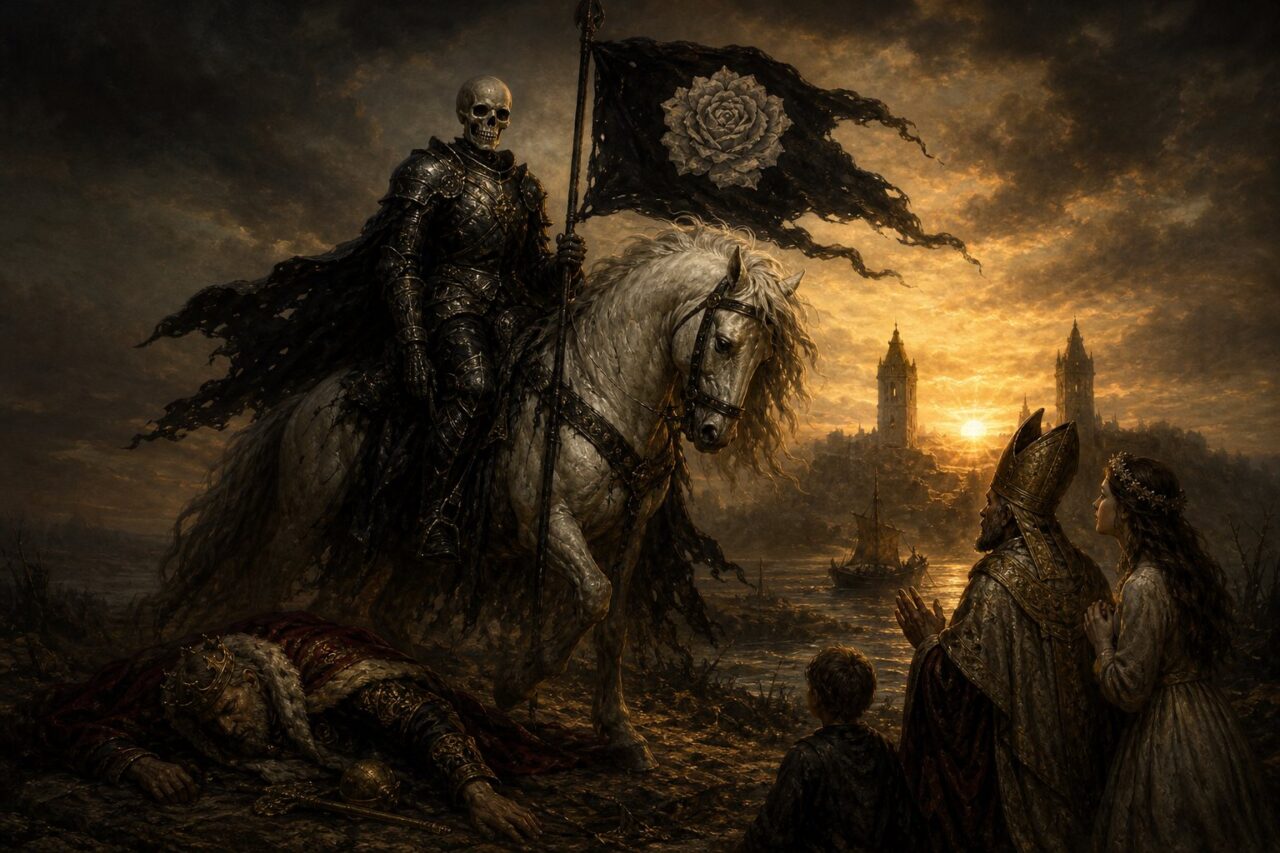
The Death tarot card often gets your full attention because its name is so direct. Yet in a reading, Death is usually not talking about physical death; it points to an ending that clears the way for transformation, transition, release, and renewal. This is the card that appears when something has reached its natural limit, even if part of you still wants to negotiate with it. It asks you to stop clinging to the old shape of your life so a truer one can form.
As Major Arcana XIII, Death describes a major turning point rather than a small mood or passing inconvenience. You may be leaving a relationship pattern, a job identity, a home, a belief, a habit, or a version of yourself that no longer fits. The change can feel sharp, but the card is not cruel; it is honest. Death says the door behind you is closing, and your peace depends on how willingly you let it close.
Death at a glance
| Arcana | Major Arcana, card XIII |
|---|---|
| Element | Water |
| Astrology | Scorpio |
| Upright keywords | Endings, transformation, transition, release, renewal |
| Reversed keywords | Resisting change, stagnation, fear of endings, inability to move on |
| Yes or no | No |
What the Death card shows
In the Rider-Waite-Smith image, a skeleton in black armor rides a white horse, carrying a black banner marked with a white rose. The skeleton shows what remains when everything temporary falls away, while the armor suggests that this force cannot be argued out of its purpose. The white horse adds movement, purity, and inevitability; the change is already underway. The black banner with the white rose speaks to a deep paradox: something ends, but within that ending is the seed of renewal.
A fallen king lies on the ground while a bishop, a young woman, and a child face Death. The king shows that status, control, and authority do not exempt anyone from transition. The bishop suggests that belief and ritual may help you meet an ending with meaning, while the young woman may show the tender human response of grief, fear, or surrender. The child faces the figure with a more open presence, reminding you that innocence can accept change before the adult mind starts bargaining.
In the distance, the sun rises between two towers and a boat sails on a river. The sunrise is crucial because it shows that the card does not end in darkness; a new day is forming beyond the immediate scene. The two towers frame the light like a threshold, suggesting you are moving from one phase of life into another. The boat on the river points to passage, emotional movement, and the need to keep flowing rather than freezing in place.
Death upright meaning
Upright, the Death card means an ending is not only likely but necessary. This can show up as a breakup you have delayed, a resignation you finally submit, a move that changes your daily rhythm, or a decision to stop being available for the same old drama. It is rarely casual; it usually touches your identity and asks you to release what has already completed its purpose. If you try to keep everything exactly as it was, you may feel more pain than if you allow the transition to happen.
Death upright is also a card of transformation, not just loss. For example, you may stop chasing approval and begin choosing relationships that feel steady and respectful. You may end a draining commitment and discover how much energy returns when you no longer spend every day managing resentment. You may leave a familiar role at work and, after the initial discomfort, realize you were ready to grow beyond it. The card does not promise that change is easy, but it does show that renewal becomes possible after release.
In practical terms, this card asks for clean action. Delete the message thread you reread to hurt yourself, clear out the closet full of a past life, close the subscription, have the honest conversation, or set the boundary you keep postponing. Death favors endings that are conscious and complete rather than vague and half-done. When you meet the card well, you stop feeding what is over and begin protecting what is trying to be born.
Death reversed meaning
Reversed, Death often shows resistance to change, stagnation, fear of endings, or an inability to move on. You may know something is finished but still keep checking for signs that it can return to the way it used to be. The card can describe staying in a job because the uncertainty of leaving feels worse than the daily unhappiness. It can also show emotional limbo, where you are not fully in the past but not yet participating in the future.
This reversal can be subtle because resistance does not always look dramatic. It may look like procrastination, overexplaining, collecting opinions, or saying you need closure when the situation has already given you enough information. You might be keeping old photos, old promises, or old hopes in a way that keeps the wound open. Death reversed asks you to notice where fear is calling itself loyalty, patience, or practicality.
The gift of the reversed card is awareness. It does not shame you for needing time; it simply shows that delaying the ending is now draining your life force. Start small if the larger release feels too much: change one routine, stop one contact pattern, clear one drawer, or admit one truth out loud. Movement breaks stagnation, and even a small act of honesty can help you begin again.
Death in love
In a relationship: Death can mark a major turning point between you and your partner. Sometimes it means the relationship, as it has been, must end; other times it means an old dynamic must die so the bond can become healthier. You may be closing a chapter of avoidance, resentment, people-pleasing, or repeating the same argument without repair. If both people are willing to change, this card can show deep transformation, but it requires more than promises.
If you are single: Death asks you to release the type of love that keeps recreating your disappointment. You may be done with unavailable partners, secret situations, chasing chemistry that brings no care, or comparing every new person to someone from the past. This is a powerful card for cutting energetic ties and making room for a different experience. Love improves when you stop trying to carry an old story into every new connection.
Reversed in love: Reversed, Death can show holding on after a relationship has emotionally ended, or refusing to let an old pattern be named. You may be waiting for someone to become who they once were, or who you hoped they would be. It can also show fear of being alone, fear of starting over, or staying because the known pain feels safer than unknown freedom. The card invites you to be honest about whether love is growing or only being preserved.
Death in career and money
At work: Death can show the end of a role, project, professional identity, or workplace chapter. You might leave a position, change industries, finish a long assignment, or realize that the way you have been working is no longer sustainable. This card often appears when the old path has become too narrow for who you are becoming. If your instincts have been telling you a season is over, take them seriously and prepare with care.
With money: Death is general guidance to review what needs to be cut, simplified, or restructured in your financial life. You may need to end a spending habit, cancel an obligation, change how you share expenses, or stop making choices based on a former income or lifestyle. This card does not guarantee loss or gain; it points to transition and the need for practical release. Make grounded decisions, get qualified advice when needed, and avoid clinging to arrangements that no longer work.
Reversed: Reversed, Death can show career or money stagnation caused by fear of change. You may be staying in a draining job because you do not want to update your resume, learn new skills, or risk rejection. Financially, it can point to avoiding a necessary review because you do not want to face the numbers. The advice is to stop letting dread make the decision for you and take one concrete step toward renewal.
Death in health and well-being
For energy and well-being, Death often points to a season of clearing, simplifying, and recovering your vitality from what drains you. This is not a diagnosis, and it should not replace medical or mental health care from a qualified professional. On a daily level, the card can suggest ending routines that leave you depleted, such as overcommitting, poor sleep boundaries, or constantly absorbing other people’s stress. Your body and spirit may be asking for a cleaner, calmer rhythm.
Death can also describe an emotional detox, where grief, fatigue, or restlessness rises because you are finally letting go of something heavy. You might need more quiet, less stimulation, and fewer obligations while you adjust to a new phase. If you are making health-related changes, keep them realistic and supported rather than extreme. The card favors sustainable release: one habit changed, one burden set down, one honest need respected.
Death as feelings
As someone’s feelings for you, Death suggests they are experiencing a profound shift. Their feelings may be changing form, moving through an ending, or forcing them to face what cannot continue as before. This can mean they feel the connection has transformed them, but it can also mean they believe a chapter between you is closing. If reversed, they may be unable to move on, yet also unable to fully step forward in a healthy way.
Is Death a yes or no?
For yes or no questions, Death leans No. The reason is that the card points to an ending, release, or transition rather than continuation in the current form. If you are asking whether something will stay the same, return unchanged, or keep going as it has, Death says no because the situation is already shifting. Reversed, the answer is still no, but the delay may come from resistance, fear of endings, or someone refusing to accept what needs to change.
For every card at a glance, see our yes or no tarot guide.
Death with other cards
- Death + The Tower: Death with The Tower can show a sudden ending that removes what was unstable anyway. The experience may feel abrupt, but it can force a necessary reset.
- Death + The Star: Death with The Star points to healing after release. A painful ending makes space for hope, recovery, and a gentler future.
- Death + Ten of Swords: Death with the Ten of Swords emphasizes finality and the need to stop reopening the wound. It is time to accept that a chapter has reached its limit.
- Death + Six of Cups: Death with the Six of Cups can describe releasing the past, childhood patterns, or nostalgia that keeps you from growing. Sweet memories may remain, but they cannot run your present life.
- Death + Ace of Wands: Death with the Ace of Wands shows new passion and motivation arriving after an ending. Once the old path is cleared, fresh desire has room to appear.
How to work with this card’s energy
- Name what is over. Be honest about the situation that has completed its cycle. Clarity reduces the emotional cost of pretending.
- Release one attachment. Choose one object, habit, message thread, or expectation to let go of this week. Small releases teach your nervous system that change can be survivable.
- Create a transition plan. If a larger ending is coming, support yourself with practical steps. Update documents, ask for help, set dates, and give yourself structure.
- Honor the grief. Even necessary change can hurt. Let yourself mourn without using grief as a reason to return to what was draining you.
Death and astrology
Death is linked to the element of Water and associated with Scorpio, which gives the card its emotional depth, intensity, and power of transformation. Water connects the card to feeling, memory, grief, intuition, and the inner tides that move beneath practical events. Scorpio adds the courage to face what others avoid: endings, truth, attachment, desire, and renewal after loss. Together, they make Death a card of deep cleansing rather than surface-level change.
Keep exploring: browse all tarot card meanings, check your daily horoscope for the astrological mood of the day, or see the key dates of the year in your 2027 horoscope.