
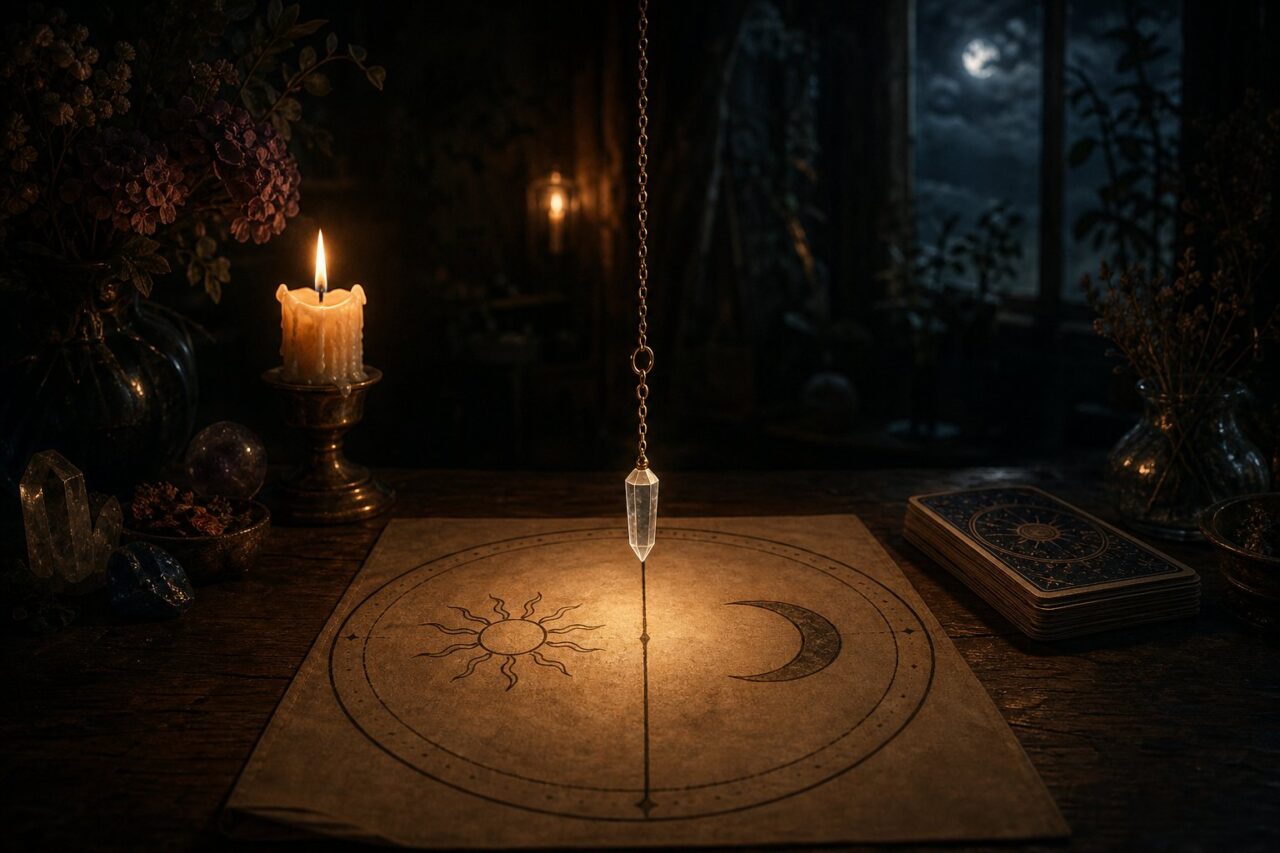
A yes or no pendulum is a simple divination tool: a weighted object on a chain or cord that swings in response to clear questions, usually showing yes, no, maybe, or unclear. You hold it still, ask a focused question, and read the direction of its movement after you have calibrated what each motion means for you.
Used well, pendulum yes no work can help you slow down, listen to your intuition, and sort through small choices. It should not replace medical, legal, financial, or safety advice, and it should never be used to control another person’s choices. Think of your pendulum as a sacred mirror, not a remote control for fate.
What a yes or no pendulum is
A yes or no pendulum is any small weight that can hang freely from your fingers and swing. Many people use crystal points, metal charms, wooden beads, rings, keys, or a necklace pendant. The tool itself does not need to be expensive or rare. What matters most is balance, comfort, and your ability to read its movement without strain.
In practical divination, the pendulum is used for closed questions: questions that can be answered with yes, no, maybe, or not clear right now. That makes it different from tarot, which often gives layered symbolic guidance. If you want a fuller story around a situation, tarot may be better. If you want a quick check on one precise question, the pendulum can be useful.
Many readers pair pendulum work with tarot. For example, you might use a spread from Tarot Card Meanings to understand the situation, then use the pendulum to clarify one practical next step. If you prefer card-based yes or no readings, see Yes or No Tarot for another method.
The key is respect. A pendulum is not a party trick when you are asking meaningful questions. Create a calm space, ask clean questions, and accept that “not now” is sometimes the clearest answer.
How do yes no pendulums work?
People explain pendulum yes and no work in different ways. Some see it as intuition moving through the body. Some see it as communication with spirit guides, ancestors, or the higher self. Others view it as a focus tool that helps bring subtle inner knowing to the surface through tiny muscle movements. You do not have to choose one belief forever. You can test the method, keep notes, and see how it behaves for you.
Physically, a pendulum moves because small shifts in your hand, breath, posture, and tension travel through the chain or cord. Spiritually, many readers believe those tiny movements can be guided by your deeper awareness or by supportive spiritual energy. This is why grounding and question quality matter so much. If your mind is racing, your hand is clenched, or you are desperate for one answer, the reading can become noisy.
So, how pendulum yes no works in practice is simple: you set a shared language with the tool, ask one clear question, wait for the movement to build, and interpret the direction based on your calibration. The process is not about forcing a swing. It is about creating the conditions for a clean response.
Use common sense alongside spiritual practice. For health, legal, money, and safety matters, treat pendulum answers as reflection, not professional instruction. If an answer would affect your body, home, children, job, or legal rights, get qualified support before acting.
How to choose or make your pendulum
You can buy a pendulum, but you can also make one with items you already own. A ring on a thread, a key on a chain, a small pendant, or a fishing weight tied to cord can work. The ideal pendulum has enough weight to swing clearly, hangs from a flexible chain or string, and feels comfortable in your hand.
If you are choosing a crystal pendulum, let the stone match the tone of your work. Clear quartz is often used for clarity. Amethyst may suit spiritual questions. Rose quartz can feel gentle for love and self-worth work. Black tourmaline or obsidian may feel grounding. These associations are traditional and intuitive rather than fixed rules. If a plain brass pendulum feels better than a crystal one, choose the brass.
- For beginners: pick a medium-weight pendulum with a visible point or center line.
- For travel: use a necklace you already wear, as long as it swings freely.
- For home ritual: keep one pendulum only for divination, stored in a pouch or small box.
- For quick practice: tie a washer, charm, or ring to a string about 6 to 9 inches long.
Before you decide, hold it for a minute. Does your hand relax? Can you see the movement easily? Do you like touching it? Your yes or no pendulum should feel clear and steady, not distracting. The more natural it feels, the easier it is to focus on the question instead of the object.
How to cleanse and prepare your pendulum
Cleansing is a way to reset the tone of your tool before a reading. You are not trying to make the pendulum perfect. You are simply clearing old energy, handling, stress, and distraction so the session starts fresh. Choose a method that is safe for the material. Some crystals can be damaged by water, salt, or sunlight, so when in doubt, use a dry method.
- Smoke cleansing: pass the pendulum through incense or herb smoke for a few seconds in a ventilated space.
- Sound: ring a bell, chime, or singing bowl near it.
- Breath: hold the pendulum and exhale slowly, imagining static leaving the tool.
- Moonlight: place it on a windowsill overnight, away from moisture if needed.
- Selenite or clear quartz: rest the pendulum beside a cleansing stone if that is part of your practice.
After cleansing, prepare yourself too. Sit with both feet on the floor. Loosen your jaw and shoulders. Take three slow breaths. You can say, “May this reading be clear, grounded, and for the highest good.” If you work with guides, ancestors, angels, or deity, invite only supportive, truthful guidance that respects free will.
Keep the mood practical. You do not need candles, music, or a full altar unless those help you focus. A clean table, steady hand, and honest question are enough. The strongest readings often come from a simple, calm setup.
How to calibrate yes, no, maybe, and unclear
Calibration means teaching yourself how your pendulum communicates. Do not assume clockwise always means yes or side-to-side always means no. Your pendulum’s language may be personal, and it can change from session to session if you do not set it clearly.
Hold the chain between your thumb and forefinger, with your elbow supported if possible. Let the pendulum hang still. Say, “Show me yes.” Wait without pushing. Watch for a direction: forward and back, side to side, clockwise circle, counterclockwise circle, diagonal, or a stronger pull. When the motion is clear, say thank you and still the pendulum. Then ask, “Show me no.” Repeat for “maybe” and “unclear.”
Next, test it with known facts. Ask, “Is my name (your real name)?” Then, “Is my name (wrong name)?” Ask, “Am I sitting down?” or “Am I indoors?” These simple questions help you learn the strength and timing of your pendulum yes no signals. If the answers are messy, pause. You may be tired, tense, or too invested.
Some readers use a chart with yes, no, maybe, and not now printed in sections. That can help beginners, but it is not required. The main rule is consistency. Calibrate before every session, especially if you have not used the tool in a while or you are asking about an emotional topic.
How to ask clear pendulum yes no questions
The quality of your question shapes the quality of your answer. A yes or no pendulum works best with one subject, one time frame, and one action or condition. If the question contains several moving parts, the pendulum may swing weakly, change direction, or give an answer that is hard to apply.
Good questions are specific and respectful. Ask, “Is it in my best interest to apply for this job by Friday?” instead of “Will my whole career work out?” Ask, “Is this apartment a supportive choice for me this year?” instead of “Will I be happy forever if I move?” You are aiming for guidance you can use, not a promise about every possible outcome.
- Good: “Is it wise for me to send this message today?”
- Too vague: “Should I do it?”
- Good: “Is this class aligned with my current goals?”
- Too loaded: “Will this class fix my life?”
- Good: “Do I need more information before deciding?”
- Too controlling: “Will Alex leave their partner for me?”
For love questions, keep the focus on your path and choices. Instead of asking what someone else secretly feels, ask what is healthy for you to do next. If you are working through a relationship pattern, The Lovers Tarot Card Meaning can help you reflect on choice, values, and honest connection.
Try a yes or no pendulum reading
Use this interactive-style practice when you want a simple reading. If your site supports randomized tools, this section can be turned into a button that displays one of four results: yes, no, maybe, or ask again later. If you are doing it by hand, follow the steps below and let your physical pendulum answer.
Step 1: Choose one question that can be answered with yes, no, maybe, or unclear. Write it down in one sentence. Step 2: Sit still, breathe slowly, and calibrate your pendulum by asking it to show yes, no, maybe, and unclear. Step 3: Ask your question once out loud or in your mind. Step 4: Watch the first clear movement that builds naturally. Step 5: Record the answer and your body response.
Suggested randomized guidance: If the result is yes, take one grounded next step rather than rushing the whole outcome. If the result is no, respect the pause and look for a safer or cleaner option. If the result is maybe, more information or time is needed. If the result is ask again later, your energy, question, or timing may not be settled.
For deeper reflection after a pendulum answer, pull one tarot card. The High Priestess is especially helpful when the message is subtle, while Justice supports questions about fairness, truth, and consequences.
Accuracy caveats, common mistakes, and ethics
Pendulum readings can feel striking, but they are not infallible. Your mood, expectations, fatigue, fear, and desire can influence the movement. If you keep asking the same question until you get the answer you want, you are no longer reading; you are negotiating with your anxiety. Ask once, record the answer, and give the situation time to breathe.
Common mistakes include asking vague questions, skipping calibration, holding the chain too tightly, reading when upset, asking about other people’s private choices, and treating every swing as a command. Another mistake is using the pendulum for decisions that require professional help. Do not use it as your only guide for medical care, legal action, investments, contracts, emergencies, or mental health support.
Ethically, stay centered on consent and free will. “Should I text Sam today?” is cleaner than “Is Sam obsessed with me?” “Is it wise for me to accept this invitation?” is better than trying to spy on someone’s hidden motives. Spiritual tools are strongest when they help you act with maturity, not when they feed control.
If you receive a frightening answer, stop. Ground yourself, drink water, and revisit the question later with calmer wording. A pendulum should not leave you feeling trapped. True guidance creates space for wise action, personal responsibility, and support from the living people and professionals around you.